


.png)

.png)
The Great Wealth Transfer Is a Finance Strategy Moment

Most conversations about the “great wealth transfer” start in fundraising. That makes sense. Over the next two decades, an estimated $84 trillion is expected to move from Baby Boomers to younger generations, with $12–$15 trillion projected to flow to charities and nonprofits.
But if you’re a finance leader, accountant, or bookkeeper at a nonprofit, this shift is not just a development problem. It is a systems, stewardship, and reporting moment. Donors across generations increasingly expect proof of impact, clarity on where gifts go, and confidence that restricted and complex gifts will be tracked as intended.
This post is a finance-led perspective on the generational giving shift, based on insights from The Great Wealth Transfer Guide (with practical program ideas for Boomers, Gen X, Millennials, and Gen Z). At the end, you’ll find a link to download the full guide and share it with your development team.
.png)
Why the great wealth transfer lands on the finance team
Your fundraising strategy can only scale as far as your operational credibility allows. When a donor asks:
- “Will my bequest be used the way I intend?”
- “How do you track restricted gifts?”
- “Can I see a clean view of funds in and funds out?”
- “How do you report results in a way that matches real financial activity?”
Those are not marketing questions. They are finance questions.
The guide’s central thesis is that generational fundraising is operational. Different generations give differently (direct mail, donor-advised funds, recurring giving, micro-gifts), and each method increases the need for:
- Consistent gift coding and allocation
- Clear restricted-fund tracking
- Defensible reporting and audit-ready records
- Faster handoffs between fundraising and finance
If the donor experience is the front door, finance is the foundation under the building—and that foundation starts with true fund accounting and clean reporting. (If you need a quick refresher, this explainer on what fund accounting is is a useful baseline.)
The donor base is changing, and “trust” is now measurable
One reason donors shift loyalty is not a lack of mission alignment. It is a lack of confidence.
The guide highlights that:
- Boomers often weigh long-term impact and institutional trust heavily.
- Gen X wants transparency and evidence that support is producing outcomes.
- Millennials value credibility, values alignment, and radical transparency.
- Gen Z is influenced by urgency, participation, and visible impact quickly after giving.
From a finance perspective, this is a shift from “thank you” stewardship to “show me” stewardship.
What “show me” looks like in practice:
- A consistent impact and financial cadence that is easy to repeat quarterly
- A “where your gift goes” breakdown that matches your chart of accounts and fund structure
- Restricted fund reporting that can stand up to board, auditor, and donor scrutiny
- Clear language development can use without overpromising
If you’re pressure-testing your current setup, it helps to anchor the conversation in the fundamentals: a clean, nonprofit-specific chart of accounts and a shared understanding of what a restricted gift actually requires of your systems.
Finance-led playbook: build reporting that works across generations
You do not need a separate reporting system for each generation. You need a single reporting spine that development can tune for different audiences.
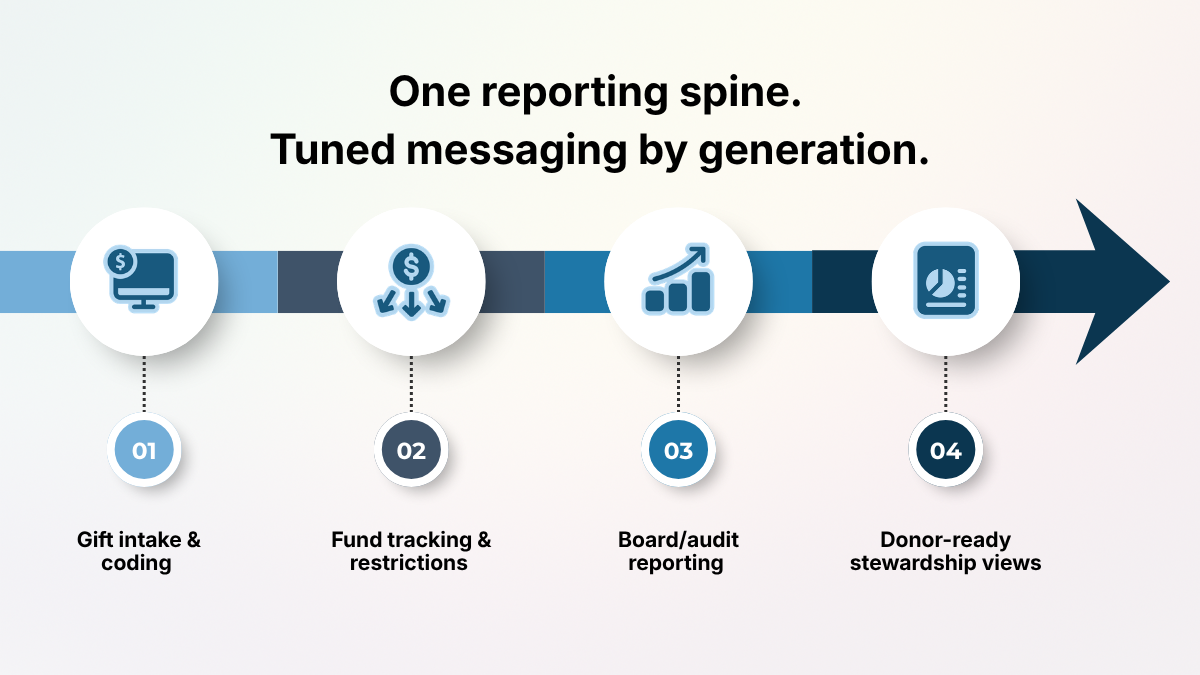
Here are three finance-driven assets that scale across donor segments.
1) “Funds in, funds out” snapshots that build confidence (Boomers + Gen X)
The guide calls out that Boomers respond to personal touchpoints and stewardship snapshots. Gen X responds to evidence and efficiency. A lightweight “funds in, funds out” view can serve both.
What to include:
- Beginning fund balance (by major fund or program area)
- New gifts received (with restricted vs. unrestricted clarity)
- Funds spent (high-level categories that match your financials)
- Ending balance
- A short note on how restrictions are honored (plain language)
This is not a full financial statement. It is a donor-facing bridge between your books and your mission reporting.
If your team needs a common language for the core reports, this overview of nonprofit financial statements is a helpful alignment tool across finance and development.
2) A restricted gift clarity standard for every campaign (Gen X + Millennials)
Outcome-based appeals and campaign scoreboards work best when finance and development agree on definitions up front.
Before a campaign goes live, define:
- What counts as “raised” (pledges vs. cash, fees, matching, stock gifts timing)
- Where gifts will be coded (fund, program, campaign, class)
- What stewardship promise will be made (and what evidence supports it)
- What post-campaign reporting will be delivered (and when)
This prevents the worst-case scenario: a campaign that performs well publicly, then creates confusion privately because reporting cannot match the story.
Two links your team can use internally as a shared reference point:
- The definition of a restricted fund (and the “why” behind it)
- The mechanics of release from restriction (so your donor-facing language stays accurate as restrictions are satisfied)
3) Radical transparency that is actually sustainable (Millennials)
Millennial donors are quick to disengage when an organization’s actions do not match stated values. “Radical transparency” is often framed as comms, but it needs a finance engine behind it.
A sustainable approach:
- Publish a “where your gift goes” page that uses consistent definitions and updates on a predictable cadence
- Create a quarterly recap template that reuses the same charts, categories, and narrative structure
- Build a simple internal checklist that ensures numbers are pulled the same way every time
Transparency is a habit, not a one-time PDF.
The hidden complexity: gift types are multiplying

As generational behaviors diversify, the variety of gifts increases too. The guide notes examples like:
- Donor-advised funds (DAFs)
- Stock gifts
- IRA qualified charitable distributions (QCDs)
- Planned bequests
- Recurring giving
- Micro-donations tied to rapid-response campaigns
Each has different timing, documentation, restrictions, and reporting expectations. The operational risk is not just bookkeeping time. It is trust leakage when donors do not feel confident the organization can steward complex gifts.
A finance team that can say “Yes, we can track that cleanly and report on it clearly” becomes a growth lever, not a back-office function.
If you’re standardizing your foundation (especially across multiple funds/programs/grants), having a consistent COA structure matters. This nonprofit chart of accounts template + example can be a practical reference when you’re auditing (or rebuilding) structure.
What to do next: align fundraising and finance around a shared strategy
If your development team is building generational programs, finance should be in the room early. The highest leverage work is often simple:
- Standardize gift coding for campaigns and donor segments
- Create donor-friendly stewardship reporting templates
- Define restrictions and reporting promises before launches
- Build a quarterly reporting cadence that fundraising can reuse
And if you’re supporting multiple entities or advising multiple nonprofits (common for accountants and bookkeepers), this on-demand session—nonprofit accounting for accountants—is a useful “same page” resource for the fundamentals and nonprofit-specific reporting expectations.
If you want the full breakdown of generational profiles and the specific programs the guide recommends for each generation, download it here:
Frequently Asked Questions
What is the “great wealth transfer,” and why should finance care?
It refers to the large-scale shift of wealth from older to younger generations over the next two decades. Finance should care because donor expectations for transparency, restricted gift stewardship, and proof of impact are rising, and those expectations depend on strong financial systems.
How do restricted gifts affect donor trust?
Restricted gifts create an explicit promise: funds will be used for a defined purpose. When reporting is unclear, inconsistent, or delayed, donors can lose confidence. Clear fund tracking and donor-ready reporting help protect trust and long-term retention.
What’s the most useful finance report for donor stewardship?
Often it is not a full financial statement. A simple, repeatable “funds in, funds out” snapshot that ties gifts to outcomes can be more useful. It should align with your actual chart of accounts and fund structure so it stays consistent.
How can finance support recurring giving programs?
Recurring giving works best when finance can reliably track recurring revenue, classify funds correctly, and provide simple reporting that shows ongoing impact. Predictable reporting helps development keep monthly donors engaged without overpromising.
Do different generations require different financial reporting?
They may respond to different storytelling, but finance can usually support all generations with the same reporting backbone. Build a small set of reusable assets and let development tailor the message and channel.

Make your accounting work for your mission today
Start your 15-day trial today. No credit card required.